
Search By Square Foot
• Up to 1000 Sq Ft
• 1001 - 1500 Sq Ft
• 1501 - 2000 Sq Ft
• 2001 - 2500 Sq Ft
• 2501 - 3000 Sq Ft
• 3001 - 3500 Sq Ft
• 3501 - 4000 Sq Ft
• 4001 - 4500 Sq Ft
• 4501 - 5000 Sq Ft
• 5001 Sq Ft And Up
Search By Square Foot
• Up to 1000 Sq Ft
• 1001 - 1500 Sq Ft
• 1501 - 2000 Sq Ft
• 2001 - 2500 Sq Ft
• 2501 - 3000 Sq Ft
• 3001 - 3500 Sq Ft
• 3501 - 4000 Sq Ft
• 4001 - 4500 Sq Ft
• 4501 - 5000 Sq Ft
• 5001 Sq Ft And Up
.png)
(1).png)
by Rachel Lyon, Editorial Director for The House Designers
Most people focus on the look of stone in photos or samples right in front of them when making a decision, but there’s more to it than that. How you install stone also has a major visual effect—so much so that you might not even recognize it as the same product in different applications! That’s why it’s a good idea to settle on an application style—dry-stack, grout joint, or overgrout—before considering aspects like shape and color, because you may find yourself unable to replicate the look you want if you don’t choose the right product for it.
Wondering where to start? You can’t go wrong with dry-stack stone. It has a long history going back millennia and is also favored for contemporary designs today. Here’s why so many homeowners select dry-stack stone, no matter their architecture.
Timeless Appeal
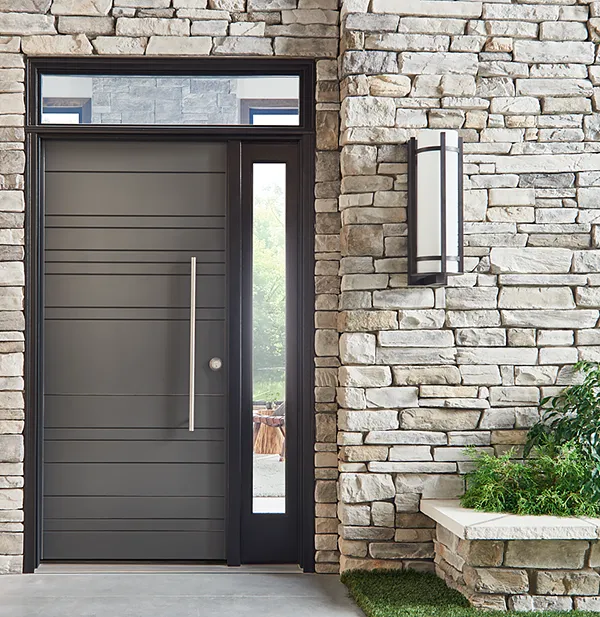
In ancient times, dry-stack stone was more a necessity than a style choice. People may have had access to stone but not mortar, or sometimes they chose to go without for practical reasons. Stone taken directly from the environment and stacked with the proper interlocking technique was incredibly durable—stone walls dating back to the neolithic age still survive across much of Europe, and you can also find them across historical sites on other continents. Here at home, they still delineate fields and property lines from colonial times in the United States!
Not only did dry-stacking walls save time and resources, because you didn’t have to source mortar and wait for it to cure, but it actually made a better choice for longevity. The reason? Because they weren’t totally solid. Rain and floodwaters could run straight through without wiping walls out. Stones themselves are pretty resistant to moisture damage, but mortar that swells and contracts with freeze-thaw cycles can weaken over the years. And beyond superior drainage, dry-stack walls also offered flexibility. If the land shifted—as it tends to over time—the individually stacked pieces could shift and settle into their new places, too. A solid wall with stones locked into place would break under the same stress.
Today, dry-stack stone is applied to walls—it does not make up the actual walls of our homes—so it needs to be adhered with mortar. But visually, it can give you the same basic look as an authentic dry-stack wall, if you choose the right stone profile. You shouldn’t see any mortar through gaps in the stone, and there’s certainly no grout between the pieces, so you still get the appearance of a stone-on-stone stack from the ground up. Whether you go with rough and rustic stone for a super traditional aesthetic or something more neat and regular, dry-stack installation offers a natural look that never goes out of style. And it’s faster and less expensive to install than with grout, making it a win all around!
Predictable & Adaptable Style
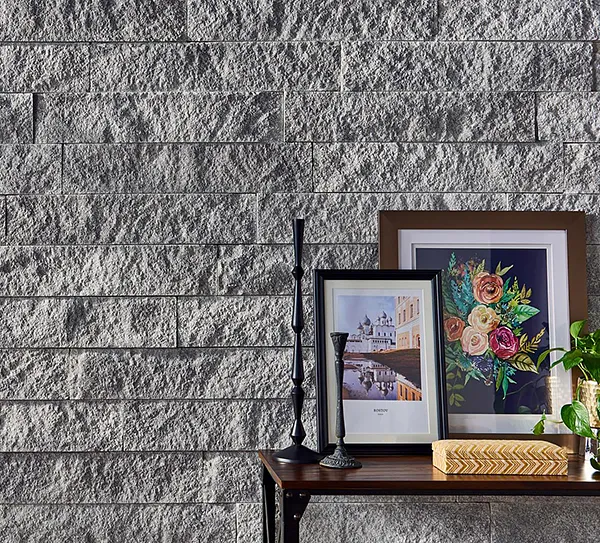
Even if the term is new to you, you’ve almost certainly seen dry-stack stone in real life. And not just at historical sites! It’s commonly used indoors and out for homes and businesses—on everything from fireplaces and building façades to accent walls and signage. People select dry-stack application not only for its practical benefits upfront, but because it lets you really appreciate the qualities of the stone. There’s no grout to fill gaps or smooth the edges around each piece, and you can choose a color/blend you like without worrying about how grout will complement it. By removing the grout variable, you’ll have a clearer picture of how each product will look for you before you buy.
Dry-stack stone makes a wonderful choice for practically any type of design because so many different types of stone can be installed this way. There are rough and rustic shapes for a natural and authentic look, of course, but dry-stack stone is now often associated with contemporary design. Why? Because we don’t have to rely on what we find in the environment anymore. You can just as easily purchase precisely shaped pieces with right corners to provide the sharp, clean lines and streamlined style that appeal to more modern trends.
Edges might set the tone first, but you’ll find plenty of other aspects to tailor stone to your vision. Consider long linear versus blocky shapes, regular versus irregular pieces, flat versus textured and faceted surfaces, and uniform versus subtle and high-contrast colors. Any and all combinations of these can be found in a dry-stackable product, so there really is something for everybody.
No matter what type of stone you have in mind for your home, Eldorado Stone offers a huge variety of profiles for your consideration—including many perfect for dry-stack installation! Some are specifically made for dry stacking while many others work well with or without grout, so explore the possibilities with an open mind. You can also find a local expert to point you in the right direction, if needed!


